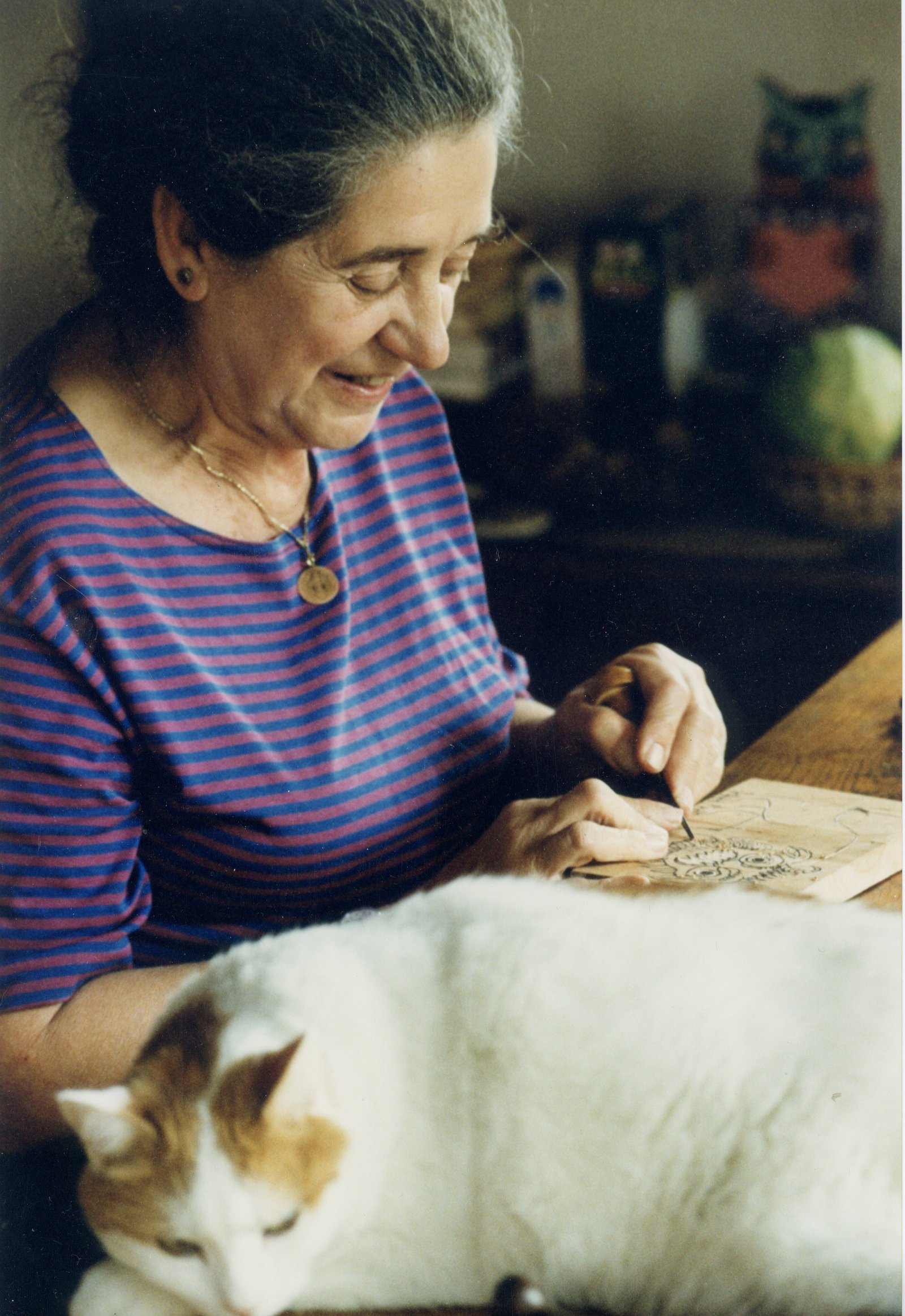
1924–2009 · Austrian-born printmaker, illustrator, and religious artist
Helen Siegl transformed experiences of war, migration, family life, faith, and political conscience into an art of unusual warmth and vitality. Across woodcuts, linoleum and plaster-block prints, lithographs, etchings, and book illustrations, children, animals, saints, and biblical figures inhabit a world animated by wonder and compassion.
Helen K. Haselberger Siegl was born in Vienna in 1924. Her artistic and moral outlook took shape during the Nazi annexation of Austria, World War II, and the postwar Soviet occupation. She studied architecture and design at Vienna's Academy of Applied Arts and spent long hours examining drawings and prints at the Albertina. Those experiences helped form an art grounded in close observation, graphic discipline, faith, and compassion.
In 1952 she married Theodor Siegl and left Vienna for Montreal. The family later settled in Philadelphia, where Theodor became conservator of paintings at the Philadelphia Museum of Art and taught at the Pennsylvania Academy of the Fine Arts. Helen raised seven sons and one daughter while sustaining a prolific career in printmaking, illustration, and exhibition. She died at her home in Big Flats, New York, on January 26, 2009.
Vienna, War, and Formation
Siegl studied architecture and design at the Academy of Applied Arts in Vienna under Oswald Haerdtl, working in his studio from 1946 to 1951. At the Albertina she studied European drawings and prints, attending closely to symbolism, composition, color, pattern, and line.
War remained part of the moral ground of her work. She experienced bombing, hunger, occupation, and the persecution of Jewish neighbors; the Philadelphia Inquirer later reported that she helped shelter Jews during the war. She answered those memories not by ignoring suffering, but by making images centered on dignity, kinship, and creative possibility.
Faith and Artistic Vocation
A devout Catholic, Siegl understood art as both spiritual inquiry and service to the wider community. Early in her career she contributed illustrations to a children's magazine founded by Benedictine monk Brother David Steindl-Rast. She considered entering the cloistered Benedictine community at Nonnberg Abbey before choosing marriage and family life.
She believed that artists should awaken people from numbness and help them see life as new creation. Her religious prints therefore avoid static piety: prophets dance, children move in circles, animals become companions, and minute natural forms are treated with reverence.
America, Family, and Printmaking
After emigrating to Canada and then settling in Pennsylvania, Siegl balanced family life with a serious artistic practice. She made relief prints from wood, linoleum, and plaster, sometimes combining processes in a single work. During wartime scarcity she devised plaster blocks as a substitute for difficult-to-obtain wood; the method became a distinctive part of her practice and brought wider attention to her work.
Her illustrations appeared in children's books, religious publications, folktales, carols, and limited editions. Subjects ranged from Aesop's Fables and Mother Goose to Turkish and Nigerian folktales. In 1991, her illustrations for Dancing Palm Tree, a collection of Nigerian tales, received recognition from The New York Times Book Review.
Publications and Exhibitions
Siegl's images reached readers through trade books, UNICEF calendars, liturgical publications, private-press works, and clip-art volumes made for church use. A 1962 review in The Harvard Crimson praised the imagination, draftsmanship, color, and technical command of approximately sixty woodcuts shown at the Paul Schuster Gallery.
Her 1995 exhibition Images from the Old Testament at St. Charles Borromeo Seminary presented colorful, intricately composed scenes including the Crossing of the Red Sea, Jonah, and the Garden of Eden. Her prints entered collections including the Philadelphia Museum of Art, the New York Public Library, the Library of Congress, and the National Gallery.
Mount Saviour and Later Years
Widowed in 1976, Siegl moved from Philadelphia to the Big Flats area in 1990, settling near Mount Saviour Monastery. Her family had visited the Benedictine community on retreat since the 1950s, and Brother David Steindl-Rast remained an important friend. As long as her health allowed, she walked through the countryside for Mass and returned for evening Vespers, working on prints between those rhythms.
The move brought prayer, studio work, hospitality, and close attention to nature into one daily pattern. Even as osteoporosis restricted her mobility, she continued to describe creativity as an affirmation of life stronger than suffering and death.
Style and Legacy
Siegl's prints combine strong black line, restrained color, simplified figures, and rhythmic or circular movement. Contemporary reviewers noted both their technical assurance and their affinity with children's imaginative life. Her work joins the familiar and mysterious: birds, beetles, flowers, children, saints, prophets, and angels coexist in a peaceable creation.
Her legacy also includes a public conscience. Shaped by wartime Europe, she opposed the Vietnam War, befriended Daniel and Philip Berrigan, and made her Philadelphia home a gathering place for antiwar activity. In art and life, she refused to separate faith from imagination, beauty from responsibility, or creativity from service.