The Chemung Valley Reporter
Illustrator Siegel Wins International Award
Friday, November 23, 1990
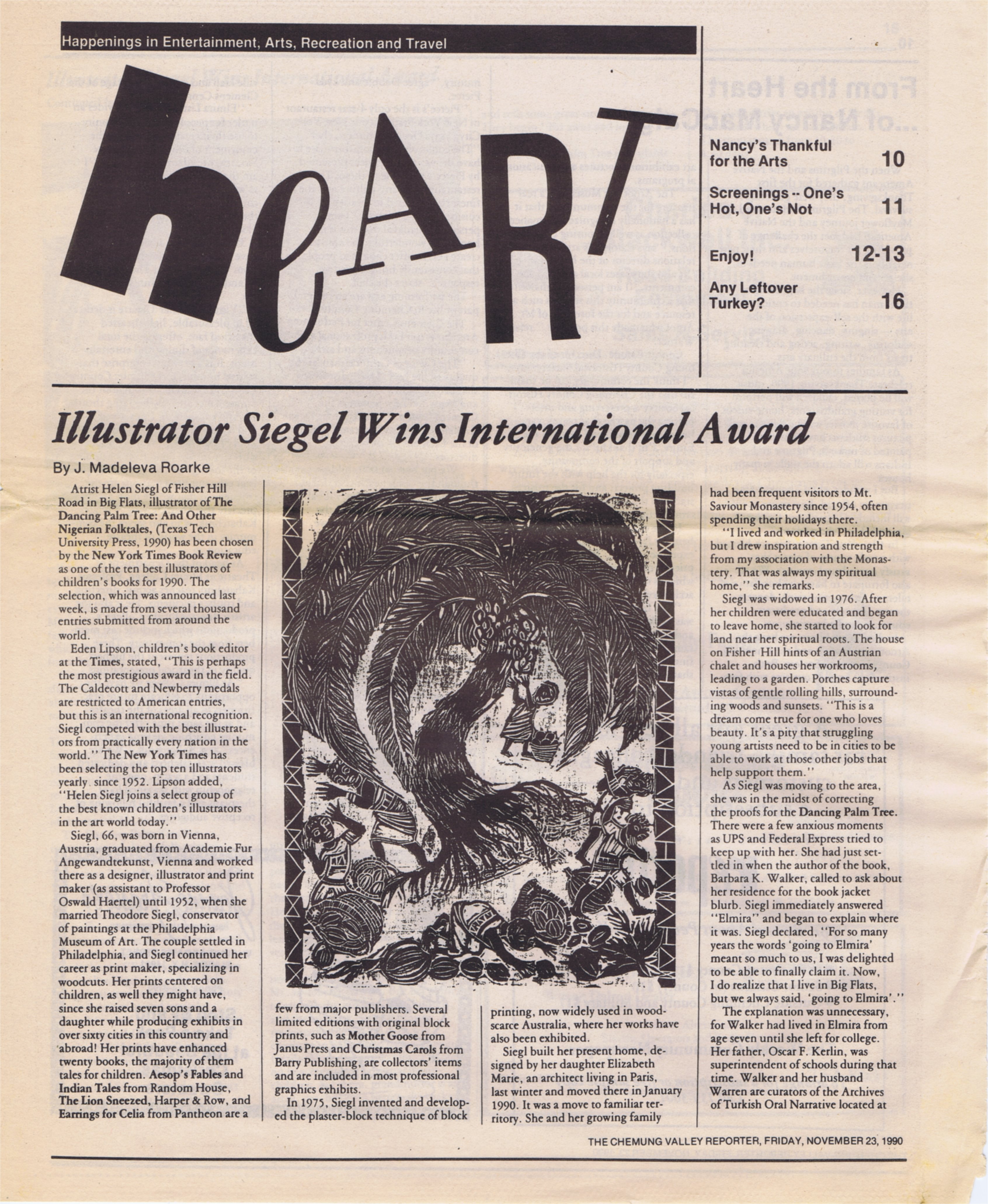
Transcription note: The text below was transcribed from the supplied newspaper page and proofread against the original image. The headline’s spelling of “Siegel” has been preserved; the article body uses “Siegl.” The supplied page ends mid-sentence.
Artist Helen Siegl of Fisher Hill Road in Big Flats, illustrator of The Dancing Palm Tree: And Other Nigerian Folktales, (Texas Tech University Press, 1990) has been chosen by the New York Times Book Review as one of the ten best illustrators of children’s books for 1990. The selection, which was announced last week, is made from several thousand entries submitted from around the world.
Eden Lipson, children’s book editor at the Times, stated, “This is perhaps the most prestigious award in the field. The Caldecott and Newberry medals are restricted to American entries, but this is an international recognition. Siegl competed with the best illustrators from practically every nation in the world.” The New York Times has been selecting the top ten illustrators yearly, since 1952. Lipson added, “Helen Siegl joins a select group of the best known children’s illustrators in the art world today.”
Siegl, 66, was born in Vienna, Austria, graduated from Academie Fur Angewandtekunst, Vienna and worked there as a designer, illustrator and print maker (as assistant to Professor Oswald Haertel) until 1952, when she married Theodore Siegl, conservator of paintings at the Philadelphia Museum of Art. The couple settled in Philadelphia, and Siegl continued her career as print maker, specializing in woodcuts. Her prints centered on children, as well they might have, since she raised seven sons and a daughter while producing exhibits in over sixty cities in this country and ‘abroad!’ Her prints have enhanced twenty books, the majority of them tales for children. Aesop’s Fables and Indian Tales from Random House, The Lion Sneezed, Harper & Row, and Earrings for Celia from Pantheon are a few from major publishers. Several limited editions with original block prints, such as Mother Goose from Janus Press and Christmas Carols from Barry Publishing, are collectors’ items and are included in most professional graphics exhibits.
In 1975, Siegl invented and developed the plaster-block technique of block printing, now widely used in wood-scarce Australia, where her works have also been exhibited.
Siegl built her present home, designed by her daughter Elizabeth Marie, an architect living in Paris, last winter and moved there in January 1990. It was a move to familiar territory. She and her growing family had been frequent visitors to Mt. Saviour Monastery since 1954, often spending their holidays there.
“I lived and worked in Philadelphia, but I drew inspiration and strength from my association with the Monastery. That was always my spiritual home,” she remarks.
Siegl was widowed in 1976. After her children were educated and began to leave home, she started to look for land near her spiritual roots. The house on Fisher Hill hints of an Austrian chalet and houses her workrooms, leading to a garden. Porches capture vistas of gentle rolling hills, surrounding woods and sunsets. “This is a dream come true for one who loves beauty. It’s a pity that struggling young artists need to be in cities to be able to work at those other jobs that help support them.”
As Siegl was moving to the area, she was in the midst of correcting the proofs for The Dancing Palm Tree. There were a few anxious moments as UPS and Federal Express tried to keep up with her. She had just settled in when the author of the book, Barbara K. Walker, called to ask about her residence for the book jacket blurb. Siegl immediately answered “Elmira” and began to explain where it was. Siegl declared, “For so many years the words ‘going to Elmira’ meant so much to us, I was delighted to be able to finally claim it. Now, I do realize that I live in Big Flats, but we always said, ‘going to Elmira.’”
The explanation was unnecessary, for Walker had lived in Elmira from age seven until she left for college. Her father, Oscar F. Kerlin, was superintendent of schools during that time. Walker and her husband Warren are curators of the Archives of Turkish Oral Narrative located at…